DICE.fm
Events
How strategic design foundations set DICE's software migration in motion.
I led the foundational UX work for migrating DICE's legacy customer support platform into their B2B product MIO, consolidating two separate platforms into one and laying the groundwork for partner self-service at scale.

Role
Product Designer
Timeline
7 weeks
Team
Designer (Me)
PM
Front-end Engineer
Back-end Engineer
UX Writer
QA Tester
Platform
Responsive SaaS Web App
OVERVIEW
DICE.fm is a live events platform helping customers discover shows and giving organisers the tools to run them.
Its B2B platform, MIO, was becoming the central hub for all event operations. However, Customer Support teams still relied on a legacy platform, Pontare, for daily tasks: assigning tickets, refunding customers and merging accounts. Running two platforms in parallel created inefficiency, risk, and limited DICE's ability to scale toward self-service.
A cross-functional team was assembled to migrate Pontare's core functionalities into MIO, consolidating operations into one platform. The first phase focused on setting the design foundations for the migration, with partner self-service as a future opportunity to unlock once the groundwork was in place.

OUTCOMES
Projected reduction in development costs.
Closer to DICE's $1M self-service goal.
B2B clients to use MIO's customer support tool, starting with a beta migration of 40+ internal users.
Design standards adopted by other squads for their own Activity Log redesigns.
Full documentation enabling the next designer to continue with confidence.
DISCOVERY
I explored how Customer Support teams operated across regions, observing agents using Pontare in real time and asking questions about their most frequent actions, how they identified duplicate accounts and why they needed to track customer orders.
This gave me a clear picture of who I was designing for, what they needed, and how the existing platform worked, which I documented into a user persona and a flowchart mapping all existing platform flows.

User persona

Close-up Pontare's flowchart
The interviews revealed how many crucial features Pontare contained, but one stood out: the Activity Log.
MIO already had its own version, but it was far less readable than Pontare's, and I was concerned we'd be forcing Customer Support to downgrade. Speaking with the engineer who built it confirmed my suspicion: no designer had ever been involved, and a redesign had never been prioritised.
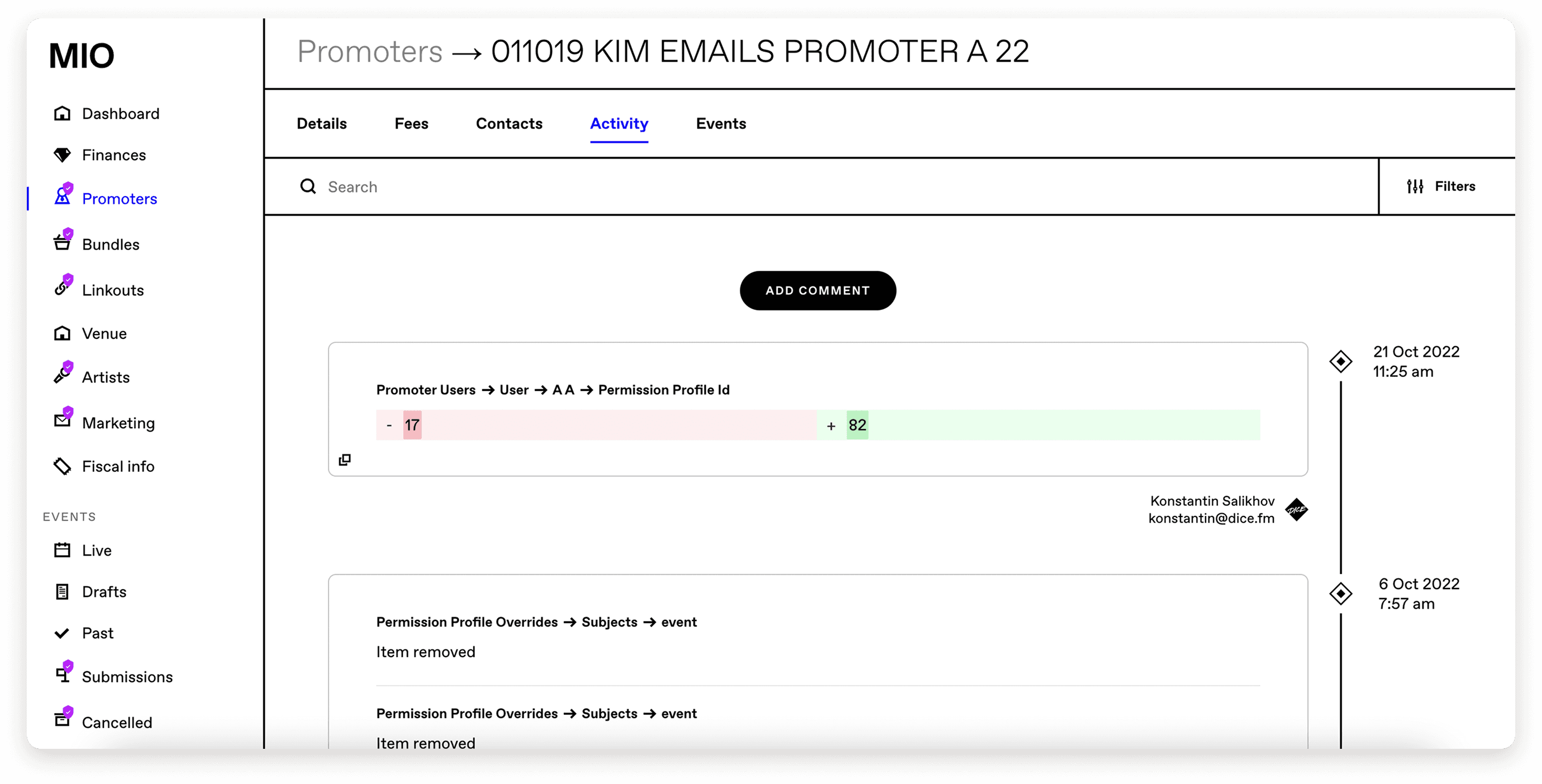
Legacy Activity Log in MIO

Some examples of Activity logs from my competitor research
UX STRATEGY
After presenting my findings to the cross-functional team, I proposed tackling the migration in six phases. I drafted a scope for each, we brainstormed together and agreed on a final list.
1- Foundational components & pages (part 1)
Customer dashboard + Search
Customer account header
Customer account activity log
Customer tickets log (past+ upcoming)
2- Foundational components & pages (part 2)
Event activity log
Customer ticket history
Refund
3- Ticket actions
Ticket transfer
Seating
Swaps
Assign ticket
Download ticket holder list
4- Login / Registration actions
Merge accounts
Update customer details
SMS
Notes
5- Waiting list
Increased visibility of customer Waiting List actions
Add / remove customer fro Waiting List
View all customers in the Waiting List for an event
6- Account actions
Block customer account
Delete skeleton accounts
Add notes to customer account
The strategy phase gave the full team a single source of truth, with the PM centralising all project information and Jira tickets in Notion. I then led the design of phase one, keeping partner self-service in mind throughout, specifically in how I organised the Fans section and the navigation patterns I chose.
DESIGN


After refining with the UX Writer, I prototyped the designs and ran remote usability tests with 9 Customer Support agents. Users responded positively to the new Activity Log but were confused by the Notes section, so we revisited that feature. More critically, 5 out of 9 users couldn't find where to search for a customer, expecting a dedicated section in the navigation.
This led to a team decision to create a new Fans section in MIO, structured similarly to the existing Events section.
DELIVERY
Working with the UX Writer, I moved Customer Search into the new Fans section and delivered the MVP for the redesigned Activity Log with a cleaner, more skimmable UI.
Scope was refined by the PM to keep the first phase focused, and I adapted the designs for smaller screens using mobile components from the design system.
Phase 1 was presented at Sprint Review, approved, and I conducted Design QA throughout development to ensure the implementation matched the designs.


